

Sakana’s Fugu Ultra, launched this week, promises to retire model selection: one endpoint, one model id, and an orchestrator that picks the right models for every task. The teams it disadvantages are the disciplined ones. The shops that built tiered routing to floor their spend just watched the lever move inside a vendor they cannot audit, while the teams that never engineered routing inherit a capable default for free.
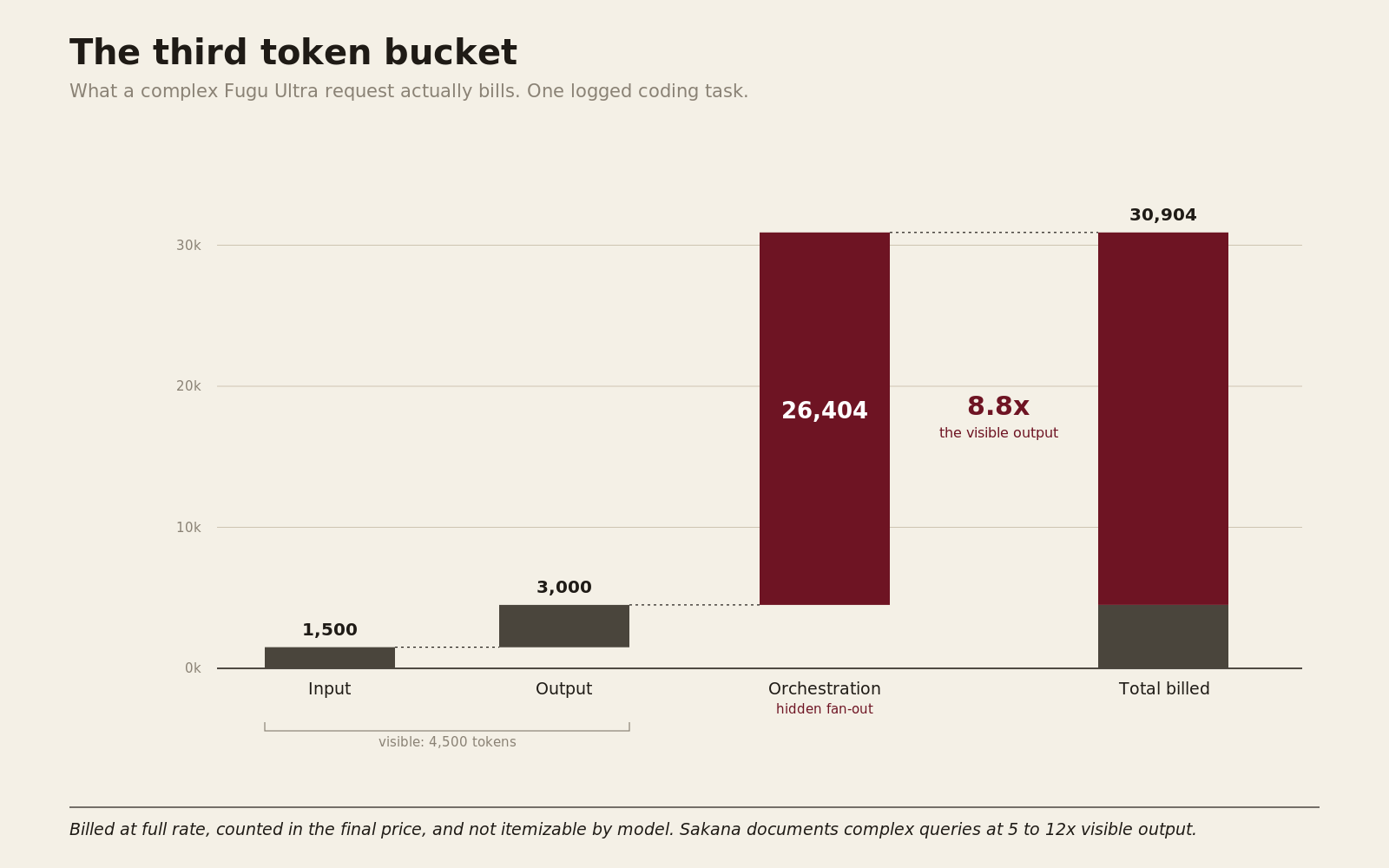
The reason sits in the bill. Sakana documents that a complex Fugu Ultra request can consume 5 to 12 times the tokens of its visible output, charged at full rate, in an orchestration bucket the caller cannot break down by model. One logged coding task carried roughly 8.8 times more orchestration tokens than visible output. The endpoint that retires routing also meters it.
Executive summary
On Fugu Ultra, an orchestrator collapses model matching and task allocation into a single model id. It replaces the caller’s per-model cost control with a coarse, vendor-defined surface, and it meters a fan-out bucket the caller cannot itemize, while still recommending direct-provider fallbacks underneath. None of this is new economics. It is the cloud-era abstraction that hid unit economics fifteen years ago, now reaching the model layer, and it transfers the FinOps advantage from the disciplined buyer to the orchestrator. The capability case for the trade is real but vendor-reported; the cost opacity is certain. That asymmetry is the decision, and it is specific to the Ultra tier.
What you actually buy
The integration is deliberately frictionless. A base URL, an API key, and the model id fugu-ultra-20260615 point an existing OpenAI-compatible client at Sakana with no SDK migration. Per request, a small coordinator decides whether to answer directly or assemble a team, routes the work across a Sakana-hosted pool of frontier models from OpenAI, Anthropic, and Google, assigns roles, verifies intermediate work, and synthesizes the result. The coordinator itself is small, the product of two ICLR 2026 papers on evolved and reinforcement-trained orchestration, so the cost is not the conductor but the agents it convenes. The caller never holds the providers’ keys and never sees their unit economics. Ultra lists at $5 per million input tokens and $30 per million output, with a higher band above a 272,000-token context, but those headline rates price only the visible half of the work. Routing, the decision that the Mode 1 and Mode 2 selection framework treats as the caller’s core job, now happens inside the endpoint, priced as a service.
The control surface that disappeared
This is where the trade bites. The three-tier model architecture that PCAS mapped in the Great Houses series was the FinOps control surface, not only a capability menu: route cheap work to the small tier, reserve the frontier tier for the few tasks that need it, and the spend has a floor the buyer sets. Fugu dissolves that surface into one model id and bills for the routing it absorbed. The lever that let a disciplined team cap cost per task is the exact lever the orchestrator now owns, which is why the teams that built the discipline are the ones who lose the advantage.
Three facts worth filing
Three mechanics decide whether Fugu Ultra belongs in a cost-accountable stack. Each is verifiable today against the API response and the published price card.
The pool is opaque. A request returns an orchestration-token total, but not which models ran or in what proportion, so per-model attribution and reproducibility leave with the routing decision: the same prompt can convene a different team tomorrow, at a different cost, for a different answer.
The tiers split on control. Standard Fugu lets a team opt specific agents out of the pool and prices dynamically by what it activates; Fugu Ultra runs the full pool at fixed pricing with no opt-out. The premium and the opacity are an Ultra phenomenon, and standard Fugu does not stack the same fee.
The third bucket is real. Alongside input and output, Sakana reports orchestration_input and orchestration_output tokens, billed at the same rate and counted in the final price. Sakana discloses the aggregate honestly; what it does not provide is a way to itemize it. A simple query carries a fixed overhead near 1,260 tokens, and a complex one runs the 5-to-12-times multiple the waterfall makes concrete.
Who wins, who loses
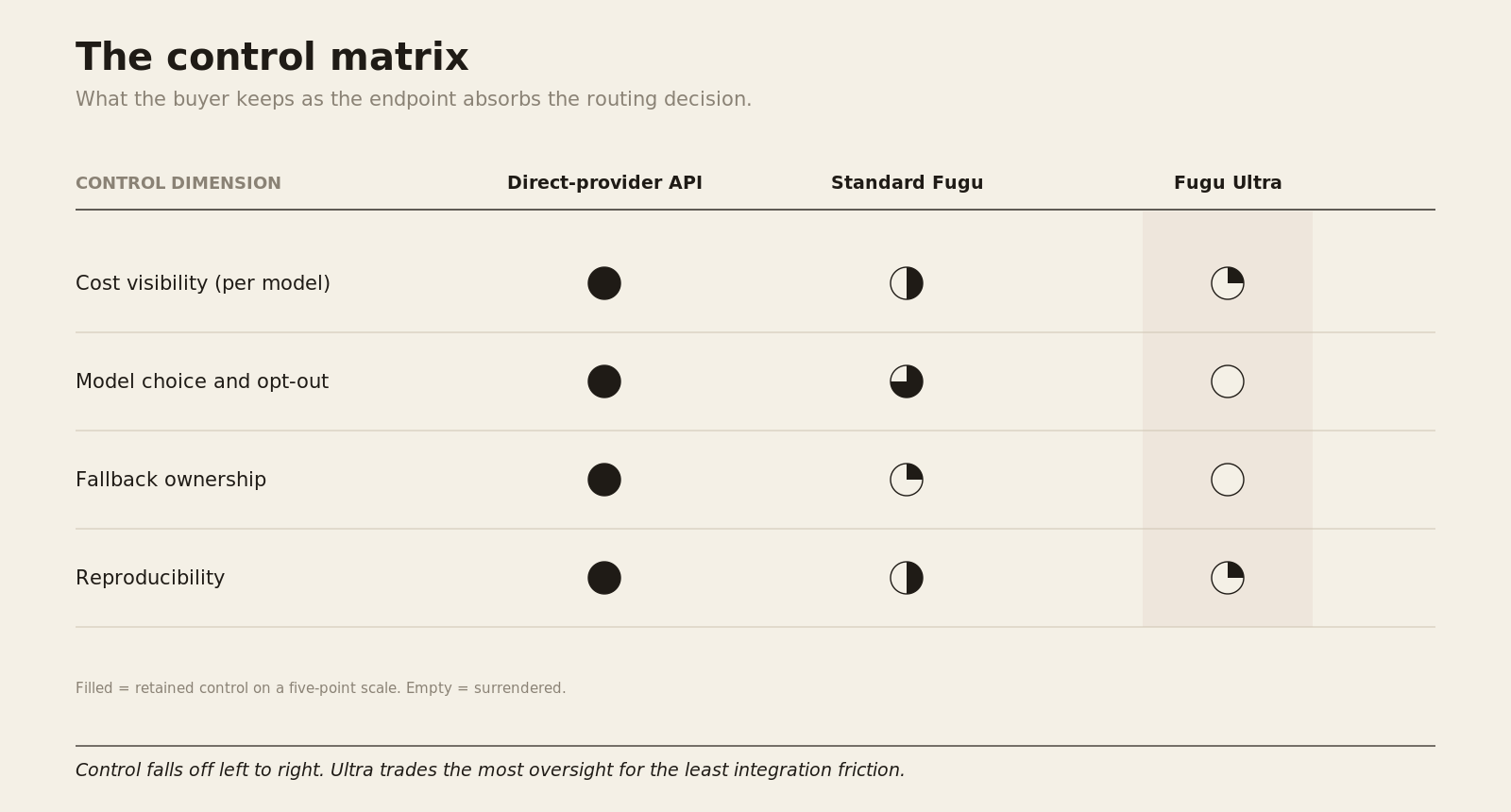
The redistribution is clean. A team that invested in disciplined routing loses its bargaining position, because the orchestrator internalizes the decision it used to own and charges for it. A team that never engineered routing gains a frontier-capable default it did not build. Fugu disadvantages the competence that careful model selection rewarded, and it rewards the buyer who never developed that competence. The control matrix sets the four dimensions that decide the call, cost visibility, model choice, fallback ownership, and reproducibility, scored across direct-provider APIs, standard Fugu, and Ultra.
The honest trade
None of this is unprecedented. Serverless functions and managed databases hid unit economics fifteen years ago, and teams accepted the opacity for the operational relief. This is the same move arriving at the model layer, a pattern PCAS traced in the AWS pricing teardown. The capability half of the trade is where the asymmetry shows. Sakana reports Fugu Ultra at 73.7% on SWE-Bench Pro, ahead of the accessible frontier models, yet below Anthropic’s export-controlled Fable 5 at 80.0, a model Fugu cannot even place in its own pool. Every benchmark is Sakana-reported and not yet independently reproduced. Latency is its own line item: independent testers have clocked Ultra requests at up to 30 minutes on hard tasks, the cost of coordinating more agents in sequence to reach that quality. The buyer accepts certain cost opacity, unverified parity, and variable latency, and then, on Sakana’s own advice, keeps a direct-provider fallback running underneath, which means paying to retain the integrations the single endpoint promised to retire.
What a cost-accountable team does
The operating posture is short and forwardable. Five moves keep the Ultra tier from quietly setting its own budget.
Log the orchestration-token ratio per task type, and reconcile it against the provider invoice every month.
Default to standard Fugu, and gate Ultra to the high-stakes requests that justify the premium and the latency.
Pin the dated model id, fugu-ultra-20260615, for anything that has to reproduce.
Keep a direct-to-provider fallback and a circuit breaker behind the endpoint.
Name the tier in every cost forecast, because the Ultra line and the standard line are different products with different economics.
The bill arrives in a column you cannot read
The abstraction is not selling capability. It is selling the end of having to choose, and the bill for that convenience lands in a column the buyer cannot decompose.