
Executive Summary
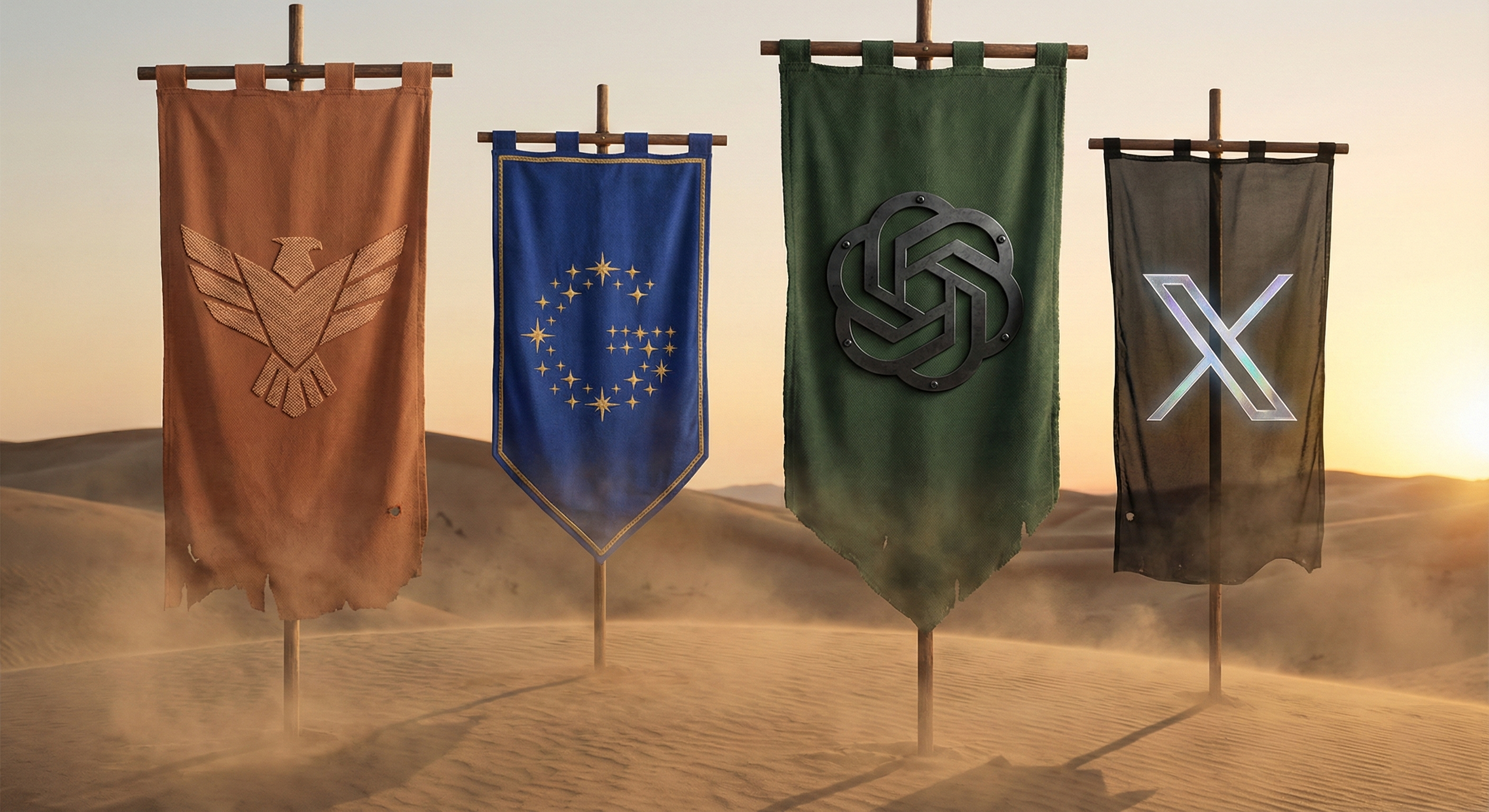
The AI model landscape has fractured into competing powers, each controlling distinct strategic territory. Four major vendors now vie for enterprise compute budgets with differentiated positioning: Anthropic’s safety-first frontier, Google’s infrastructure scale, xAI’s pricing disruption, and OpenAI’s market ubiquity.
Selecting models requires understanding not just capability benchmarks, but strategic positioning. Vendor claims diverge significantly from independent validation (often 5-10 percentage points on coding benchmarks). Multi-tier deployment strategies enable 75-85% cost reduction when models match workflow requirements.
This article introduces a framework for navigating model selection, drawing on an unexpected source: the strategic logic of Frank Herbert’s Dune. Subsequent articles provide detailed guidance for each vendor family, SDLC phase optimization, and cost optimization playbooks.
Lessons from Arrakis
Anyone who spent 1992 commanding harvesters across desert terrain understands resource-based strategy. Dune II didn’t just pioneer real-time strategy gaming; it taught a generation of future executives how competing powers with asymmetric advantages contest scarce resources.
Three houses fought for spice on Arrakis. House Atreides fielded disciplined infantry and versatile ornithopters. House Harkonnen deployed heavy armor and overwhelming force. House Ordos relied on speed, deception, and unconventional tactics. Victory required understanding not just your own capabilities, but how rivals would deploy theirs.
The AI model landscape operates on similar logic. Four major houses now compete for enterprise compute budgets, each controlling distinct strategic territory. Understanding their positioning illuminates model selection in ways that benchmark tables alone cannot.
The Four Houses
House Anthropic (Atreides)
Claude’s positioning mirrors Atreides discipline: measured releases, principled constraints, emphasis on reliability over raw capability claims. Opus leads independent coding benchmarks (Vals.ai #1). Sonnet captures the balanced middle ground. The November 2025 Opus 4.5 launch disrupted pricing with a 66% reduction ($5 vs $15 input), expanding frontier access without abandoning quality positioning.
Atreides didn’t win through overwhelming force. They won through competence, loyalty, and strategic patience. Claude’s market position reflects similar logic: build trust through consistent quality, let competitors’ aggressive claims create credibility gaps when independent testing arrives.
House Google (Corrino)
The Padishah Emperors controlled the Imperium not through direct combat superiority, but through resource control: the Sardaukar, CHOAM shares, and ultimately the spice itself. Google’s power derives from similar foundations: data centers at planetary scale, training data from Search and YouTube, distribution through Workspace and Android.
Gemini 3 Pro dominates reasoning benchmarks (37.4% Humanity’s Last Exam, highest recorded). The Flash tier creates unprecedented budget deployment options ($0.10 input). Google doesn’t need to win every benchmark. Controlling infrastructure and distribution creates strategic advantages that transcend model capability comparisons.
House xAI (Ordos)
House Ordos didn’t appear in Herbert’s novels. Westwood Studios created them for Dune II as the unconventional third faction: faster units, deception tactics, economic warfare over direct confrontation. They won by changing the rules of engagement.
Grok 4.1 Fast represents exactly this approach. At $0.20 input with 2M context, xAI offers 84% cost savings versus GPT-5 and 97% versus Claude Sonnet 4 1M for extended context workflows. The trade-off is real: mechanical prose unsuitable for executive communications. But for operations, preliminary research, and internal documentation, the economics reshape what’s viable.
Ordos players learned to avoid direct confrontation with Harkonnen heavy armor. Grok users should similarly avoid executive deliverables where communication polish matters. Play to asymmetric strengths.
House OpenAI (Harkonnen)
Setting aside the Baron’s personal excesses, House Harkonnen’s strategic position derived from industrial might, first-mover advantage, and willingness to deploy overwhelming resources. They controlled Arrakis before Atreides arrived. They invested heavily in military infrastructure. They accepted costs rivals wouldn’t bear.
OpenAI built the market. GPT-3 created the category. GPT-4 defined enterprise expectations. That first-mover advantage translates to the largest deployment footprint, the most extensive integration ecosystem, and brand recognition that simplifies procurement. The GPT family offers broad capability coverage without clear leadership in any single dimension: viable across diverse workflows, but often outperformed by specialists (Claude for coding, Gemini for reasoning, Grok for price).
Harkonnen players in Dune II learned that industrial production advantages compound over time. OpenAI’s market position reflects similar dynamics: even when individual models trail competitors, ecosystem effects and switching costs maintain strategic position. 🏜️
The Methodology Problem
Vendor benchmarks tell stories vendors want told.
Anthropic reports Claude Opus 4.5 at 80.9% SWE-bench. OpenAI claims GPT-5.1-Codex-Max at 77.9%. These figures appear in product announcements, sales materials, and capability comparisons.
Independent testing reveals tighter clustering. Vals.ai standardized evaluation (single-attempt, standardized prompts, public scoring) shows Claude Opus 4.1 at 72.7% and Sonnet 4.5 at 69.8%. The 8-11 percentage point gap between vendor claims and independent validation reflects methodology differences, not measurement error:
Vendor methodology: Multiple attempts with best-result selection. Extensive prompt optimization specific to each model. Internal scoring models. Parallel compute and optimized infrastructure.
Independent methodology: Single attempt reflecting practical deployment. Standardized prompts across all evaluated models. Human evaluation or deterministic grading. Standard API access.
Neither approach is wrong. They measure different things. Vendor benchmarks show ceiling capability under optimal conditions. Independent benchmarks show floor capability under practical conditions. Enterprise deployments experience something closer to independent conditions.
This series prioritizes independent validation (Vals.ai, LMArena, Artificial Analysis, academic research) over vendor self-reporting. Where vendor and independent results diverge significantly, we note methodology differences explicitly.
The Series Ahead
Understanding the strategic landscape enables tactical model selection. This series provides detailed guidance across multiple dimensions:
Model Family Guides examine each house’s portfolio in depth. Which Claude variant for which workflow? When does GPT-4.1’s extended context justify its coding capability trade-off? Where does Grok’s pricing advantage actually apply? How does Gemini’s Flash tier compare to Pro?
SDLC Phase Optimization matches models to development lifecycle stages. Design phase errors cost 10-100x more to fix than initial decisions: premium reasoning models justify their cost. Operations phase prioritizes speed and cost efficiency: budget models excel. Testing phase benefits from reasoning models that identify edge cases through systematic analysis.
Organizational Role Mapping addresses non-engineering workflows. Process documentation requires language quality unavailable from budget models. Compliance validation demands accuracy levels (99%+) that eliminate certain options. Executive communications need polish that LMArena Elo scores can predict.
Cost Optimization Playbook demonstrates how multi-tier routing achieves 75-85% cost reduction. Single-model strategies sacrifice efficiency. Matching capability tiers to workflow requirements preserves quality while eliminating waste.
Reading the Battlefield
The spice must flow. So must the tokens.
Each house brings distinct advantages to the contest. Atreides discipline produces reliable quality. Corrino infrastructure enables scale. Ordos economics reshape viability. Harkonnen market position simplifies procurement.
Winning requires matching house capabilities to strategic objectives. Using Grok for board presentations wastes its cost advantage through revision cycles. Using Claude Opus for log analysis wastes capability on tasks where speed matters more than polish. Using Gemini Flash for architecture decisions creates downstream costs exceeding initial savings.
The guides that follow provide the tactical detail. This framework provides the strategic context.
Choose your house wisely. The desert is unforgiving to those who misread the terrain.
Next in the series: Claude Model Selection: Opus, Sonnet, and Haiku Decoded