
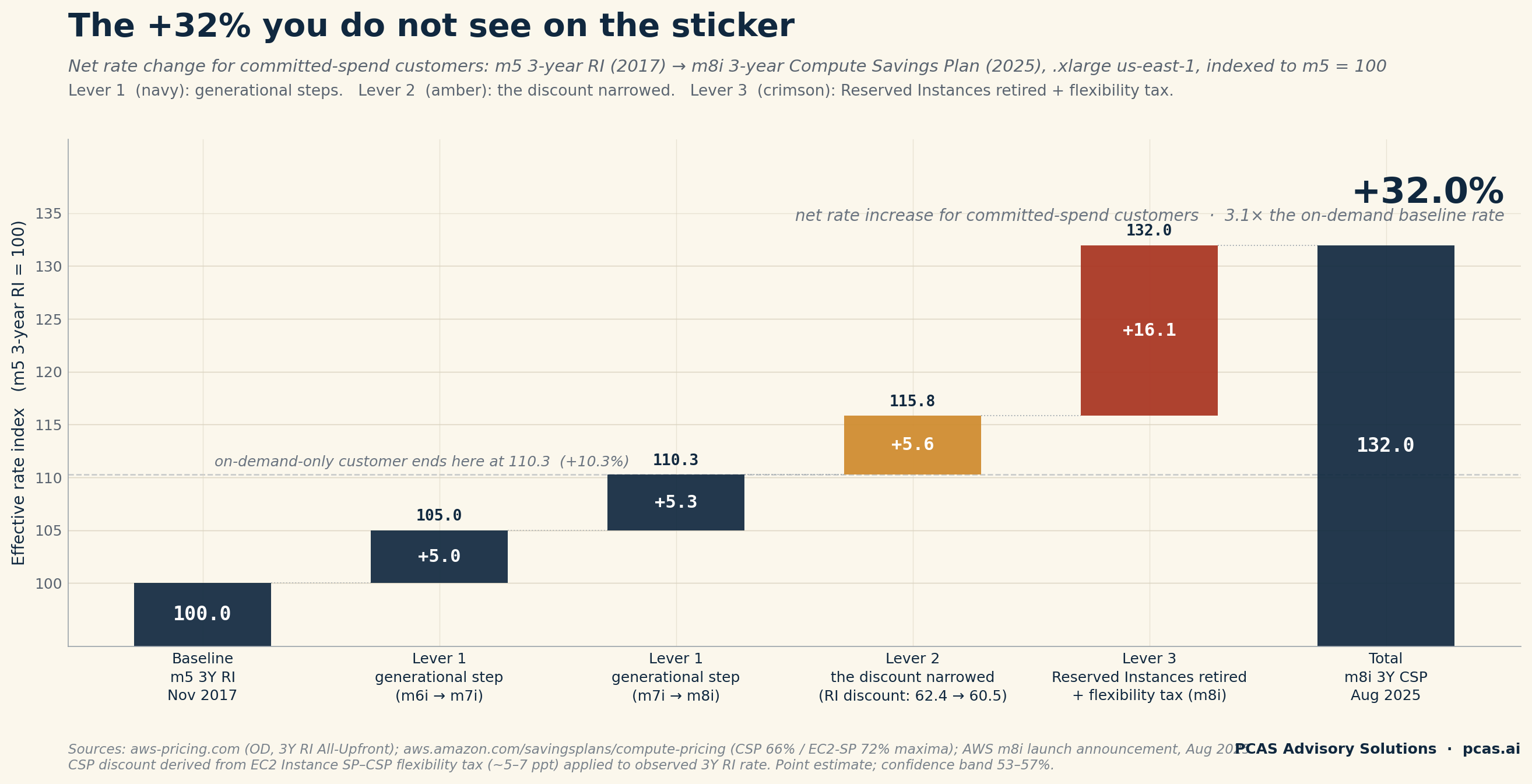
Across eight years and four generations of general-purpose Intel EC2 instances, AWS has not raised the on-demand hourly rate of any existing SKU. That is the simple story, and it is technically true. The chart above is the rest of it. For the customer with multi-year spend commitments, the rate experienced rose 32 percent across the same window: three forces compounded to produce that figure, only one of which moved the on-demand sticker.
This is the picture before the producer-price wave reaches the bill.
The Bureau of Labor Statistics index that tracks printed circuit assemblies, modules, and boards just printed the steepest year-over-year move in its recorded history. From approximately flat in mid-2025, the index reached +150 percent by April 2026. The consumer computers and peripherals index, deflationary for most of the prior decade, has only just turned positive at +3 percent. The gap between those two lines is two to three quarters wide and it is where the corporate technology buyer is currently standing.
That gap reflects a procurement order. Server DDR5 contract prices rose 58 to 63 percent quarter over quarter in 2Q26. NAND moved 70 to 75 percent in the same window. High-bandwidth memory used in AI accelerators is allocated through 2026 by multi-year supply agreements with hyperscale buyers whose capital expenditure now approaches $600 billion annually, roughly 30 percent of which goes to memory. The data-center buyer paid first. The OEM channel passes it through next. The consumer index sees it last.
The question for executives is what happens at the cloud-pricing layer, between the OEM channel and the customer invoice. AWS is the largest such layer in the world, and its eight-year record since the last DRAM super-cycle is the cleanest case study available.
Why now
AWS launched its eighth-generation general-purpose Intel instance family (m8i) in August 2025. The next refresh is roughly two years out. Published commitment rates that have been stable for two generations are the customer’s last anchor before the producer wave reaches the bill. The decisions made in the next two quarters on Reserved Instance and Savings Plan coverage will lock the rate envelope for the next three years. The window is narrow and closing.
The visible claim, verified
AWS, by its own count, has reduced prices across its services 134 times since launch in 2006. It has not raised the on-demand hourly rate of any existing EC2 instance type. The m5.xlarge instance launched in November 2017 at $0.1920 per hour in us-east-1, and that rate has held for 8.5 years. The marketing claim is technically accurate.
That is also where the simple story ends.
Lever 1: generational steps
Each new generation launches at a higher rate than the one it follows. m7i launched 5 percent above m6i in 2023. m8i launched 5 percent above m7i in 2025. The cumulative on-demand step from m5 to m8i is +10.3 percent across eight years, roughly 1.2 percent per year. Against the inflation backdrop of the same window this is modest, and it is the lever every analyst report references. AWS would prefer the conversation stays here.
Lever 2: the discount narrowed
The 3-year Reserved Instance All-Upfront discount on m5.xlarge at launch was 62.4 percent off on-demand. The same discount on m6i, launched in 2021, was 60.5 percent. The discount narrowed 1.9 percentage points. The on-demand sticker did not move. The effective rate for the customer with a multi-year commitment did, because the discount was smaller in dollar terms.
The timing is informative. AWS introduced Savings Plans in November 2019 as a parallel purchase option designed to migrate customers from instance-specific Reserved Instances into more flexible commitment vehicles. The m5-to-m6i discount compression coincides almost exactly with that purchase option becoming available. The compression is identical across us-east-1, us-east-2, eu-west-1, and eu-central-1, which rules out a regional cost pass-through and confirms a global pricing-policy action.
Lever 3: Reserved Instances retired on new generations
m8i launched in August 2025. The AWS news blog announcement reads, verbatim, “M8i and M8i-flex instances can be purchased as On-Demand, Savings Plan, and Spot instances.” Reserved Instances are notably absent from the list. This is policy, not data gap.
AWS publishes two headline maxima for Savings Plan discounts on its pricing page: up to 66 percent off on-demand for Compute Savings Plans, up to 72 percent off for EC2 Instance Savings Plans. The 6-percentage-point gap is the flexibility tax. EC2 Instance Savings Plans commit to a specific instance family in a specific region, which is what most steady-state production workloads already do. Compute Savings Plans give up that specificity in exchange for cross-family and cross-region portability, at a 5 to 7 point narrower discount.
For m-family in us-east-1, the 3-year EC2 Instance Savings Plan rate sits at functional parity with the 3-year Reserved Instance rate, around 60.5 percent off. The 3-year Compute Savings Plan equivalent discount is therefore approximately 55 percent. The customer whose architecture maps cleanly onto EC2 Instance Savings Plans preserves the higher discount. The customer whose workload sprawls across families and regions falls into Compute Savings Plans by default and accepts the narrower one.
The compounded result
Holding the same .xlarge shape constant in us-east-1, across m5 to m8i:
- On-demand price: $140.16/mo to $154.53/mo = +10.3 percent
- Best-available committed rate: $52.69/mo (m5 3-year RI) to $69.54/mo (m8i 3-year CSP estimated) = +32.0 percent
- Net rate increase for committed-spend customers: 3.1 times the on-demand baseline rate
The customer running on-demand saw a 10 percent increase in eight years. The customer doing what AWS recommends in every architecture review (commit to a multi-year purchase option for production capacity) saw a 32 percent net rate increase. The single largest step is the m7i 3-year RI to m8i 3-year CSP refresh: 5 percent on-demand step, 19.6 percent committed-rate step, 3.9 times multiplier on a single refresh. The customer whose behavior most closely matched AWS’s published advice paid the most.
What comes next
This is the picture before the producer wave reaches the bill. The OEM channel already carries roughly 15 percent published price increases on standard servers from Dell, HPE, and Lenovo. Those costs sit in the hyperscaler procurement function’s books now. The question is which lever AWS pulls to recover them.
Three paths sit in front of the hyperscaler. The first is absorption, taking margin compression to hold on-demand flat. AWS ran this play through 2024 and the first half of 2025 while existing Reserved Instance contracts still covered a high share of fleet usage. As those run off, absorption gets harder. The second is pass-through on new generations: m9i, likely 2027 to 2028, is the first M-family generation priced into a rising memory curve. The historical +5 percent generational step is the floor, not the trend. A +10 to +15 percent step is consistent with the producer signal and the closing tailwind. The third is steerage toward Graviton, the ARM-based silicon family AWS designs in-house. Graviton has carried a 10 to 20 percent discount versus equivalent x86 for two years. As AWS manages memory exposure on its own balance sheet, that gap is likely to widen rather than narrow. The cheapest way for any company to capture margin without flagging it as inflation is to push customers toward a product the company controls end-to-end.
The realistic answer is a blend of the three. The lever pulled hardest will be the one customers see least clearly. The Compute Savings Plan rate sits at the top of that list.
What this means for executives
Reserved Instances and Savings Plans are published rates. Neither is individually negotiable. The lever the executive controls is upstream of the rate sheet: the architecture decisions that determine which purchase option the workload qualifies for at all.
First, embed FinOps in the architecture review. Application teams should size new infrastructure on EC2 Instance Savings Plan effective rates, not on-demand list pricing. That single change to the cost model in early-stage design reviews shifts which architectural patterns look defensible. Over a multi-year planning horizon, designing for predictable node families is worth roughly 5 to 7 percentage points of discount versus the Compute Savings Plan rate that fragmented fleets default into. The architecture team owns that decision and it pays for itself.
Second, standardize compute through EC2-backed EKS and ECS. Container orchestration on standardized node groups produces exactly the kind of predictable instance-family-and-region commitment pattern that EC2 Instance Savings Plans were designed for. A function-sprawled or mixed-family fleet has no predictable shape and lands in Compute Savings Plans by default. Container standardization is the bridge between application portability and commitment economics, and it is the cheapest single architectural decision available to most enterprises this year. Scale earned through consolidation is what makes responsible architecture pay for itself.
Third, treat Graviton portability as a structural hedge. ARM substitution is the most likely steerage path AWS pulls as memory costs rise. Workload portability work done in 2026 preserves option value against pricing actions in 2027 and 2028. ARM portability is not a technical project. It is a commercial option, and it pays for itself in the rate sheet at the next refresh.
The bottom line
The producer-price wave is the loudest signal in IT hardware since the last DRAM super-cycle in 2017-2018. It has not yet reached the cloud bill in any visible way, which is exactly what makes the next two quarters the right time to act. AWS’s eight-year record shows the on-demand sticker telling the simple story while the committed rate tells the real one. Both have been published the entire time. The customer paying attention to one number paid for the other.
Sources:
- aws-pricing.com regional and Reserved Instance tables, May 2026
- Compute and EC2 Instance Savings Plans pricing - AWS
- m8i launch announcement - AWS News Blog, Aug 28 2025
- BLS PPI: Printed Circuit Assemblies and Modules via FRED
- TrendForce: DRAM and NAND contract price increases 2Q26
- AWS Public IPv4 Address Charge announcement, Feb 2024