
Executive summary
Enterprise software engineering with AI has split into two operating models that PCAS labels Mode 1 and Mode 2. Mode 1 augments the existing development lifecycle: agents draft code, generate tests, and review pull requests inside phases humans still own. Mode 2 collapses the lifecycle into agentic loops: high-level intent feeds an agent that plans, builds, and self-verifies, with humans steering at the risk level. Public evidence now exists for both, and it points to durable coexistence. Measured Mode 1 gains run 10 to 20% with high variance by work type. Mode 2 production cases include 1,500+ merged PRs at Spotify and a 750,000-line runtime port completed in 11 days. Yet engineers fully delegate only 0 to 20% of tasks even while using AI in about 60% of their work. That gap, the platform investment Mode 2 requires, and the pricing split vendors introduced this quarter hold both modes in place through the medium term: in PCAS’s read, the next 20 to 26 months.
Two engines, one ship
The starship Enterprise carries impulse engines and a warp drive. Impulse handles maneuvering, docking, and close-quarters work under direct control. Warp covers distances impulse cannot, and it engages only when conditions allow. No engineer on board proposes removing one because the other exists. Agent-based development now runs the same dual-propulsion arrangement, and the design question follows directly: which engine does the maneuver in front of the team call for? 🖖
What the two modes are
Mode 1 and Mode 2 describe how an engineering organization structures AI within its software development lifecycle. Neither term names a tool or a model choice. Both are operating models, and a single organization typically runs both at once.
The vocabulary is PCAS’s own; the industry has not settled on names for this split even as it shows up in vendor pricing, benchmark design, and production case studies. The framing earns its place because mode confusion, treating one model’s evidence, economics, and skill demands as if they applied to the other, now wastes more enterprise AI spend than model selection does. This series argues that position.
Mode 1: augmentation. AI assists inside the existing SDLC. Requirements get written, designs get reviewed, code moves through pull requests, releases follow a cadence, and agents accelerate each step. Humans own the workflow structure and the handoffs. Token cost tracks workflow volume, which keeps spend predictable.
Mode 2: agentic loops. The phase boundaries dissolve. Intent feeds an agent or multi-agent system that plans, implements, tests, and self-corrects in a continuous loop, with observability providing the feedback signal. Humans steer at the intent and risk level. Cost is harder to predict because token volume depends on how deeply the loop iterates.
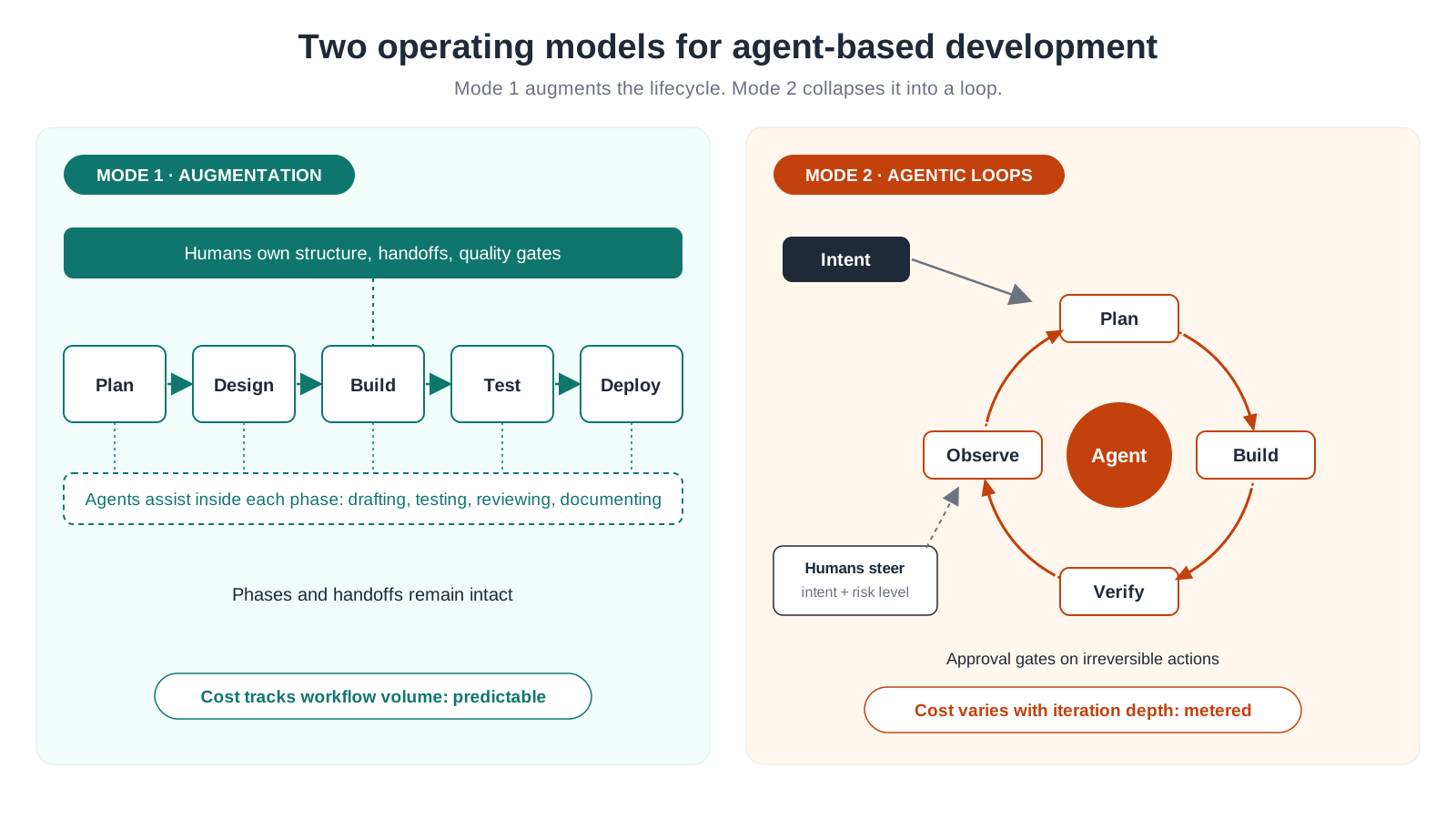
Production Mode 2 still falls well short of lights-out autonomy. The working form is bounded autonomy: sandboxed execution, mechanical verification, and human approval gates on irreversible actions such as production deploys and schema changes. Part 3 examines that machinery in detail.
What the public numbers say
The two modes carry different kinds of evidence, and the difference matters for planning. Mode 1 has controlled measurement behind it. The Stanford/P10Y analysis of roughly 100,000 developers across 600+ companies finds a median productivity lift of 10 to 15%, with 30 to 40% gains on greenfield work in popular languages and zero to negative returns on brownfield maintenance. The METR randomized controlled trial found experienced developers 19% slower with AI on repositories they knew well, even as they forecast a 24% speedup. Anthropic’s January 2026 Economic Impact Index describes the current state as “primarily augmentation, not automation.”
Mode 2 has production case studies rather than controlled trials. Spotify’s Honk background agent has merged 1,500+ AI-generated PRs with 90% time savings on fleet-wide migrations. Rakuten ran a seven-hour autonomous session inside the 12.5 million-line vLLM codebase, cutting time-to-market on a complex refactor from 24 days to five. In May 2026, the Bun runtime was ported from Zig to Rust, roughly 750,000 lines across 6,755 commits, in 11 days with 99.8% of the existing test suite passing.
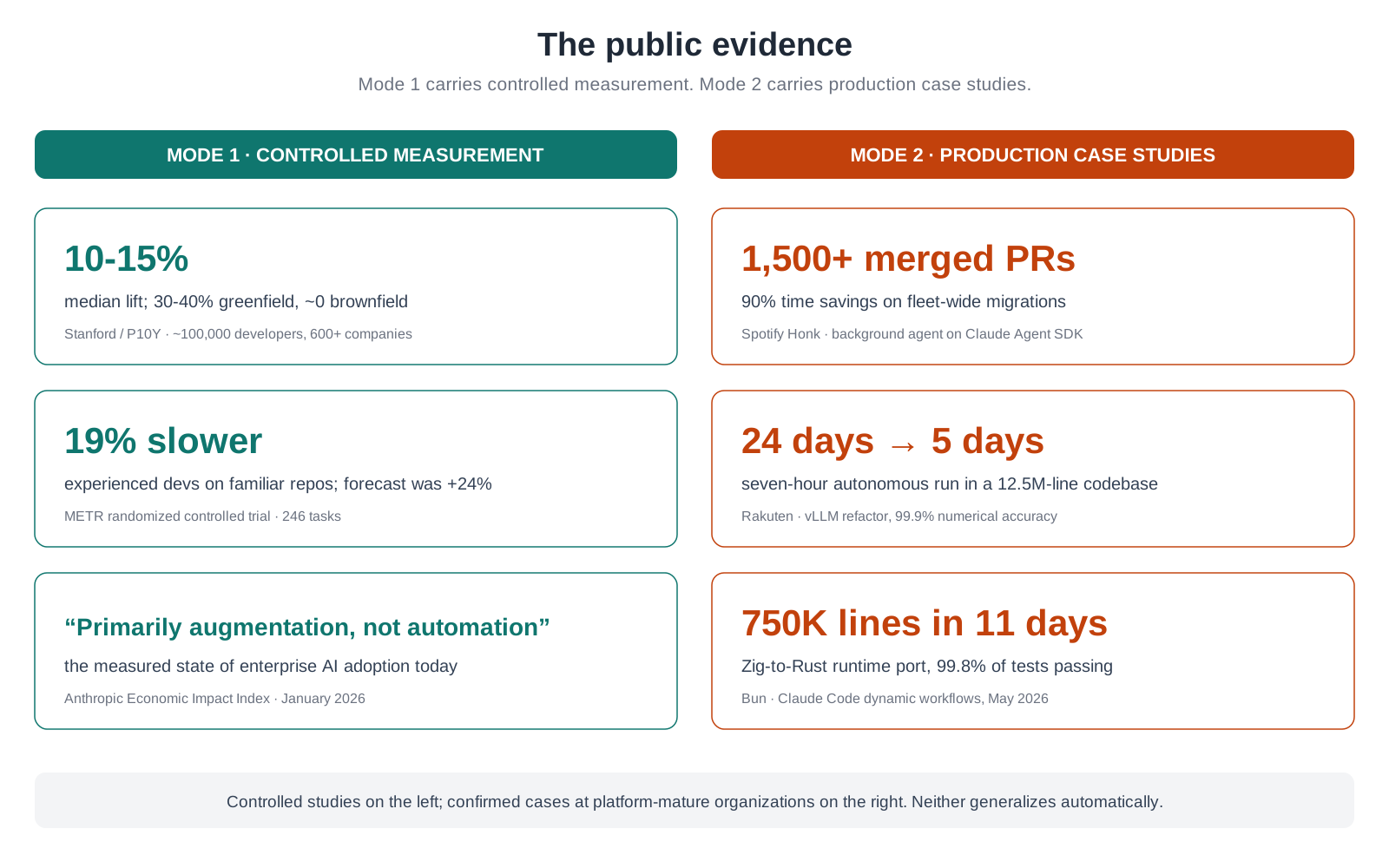
Source discipline applies here. The Mode 1 figures come from controlled studies with published methodology. The Mode 2 figures are confirmed case studies, but each occurred at an organization with unusual platform maturity. Neither set generalizes automatically.
Why the modes coexist through the medium term
PCAS puts the medium term at 20 to 26 months: long enough for platform investments to mature, short enough that the delegation gap stays open. Three structural forces keep both modes in operation across that window, and each is visible in public data today.
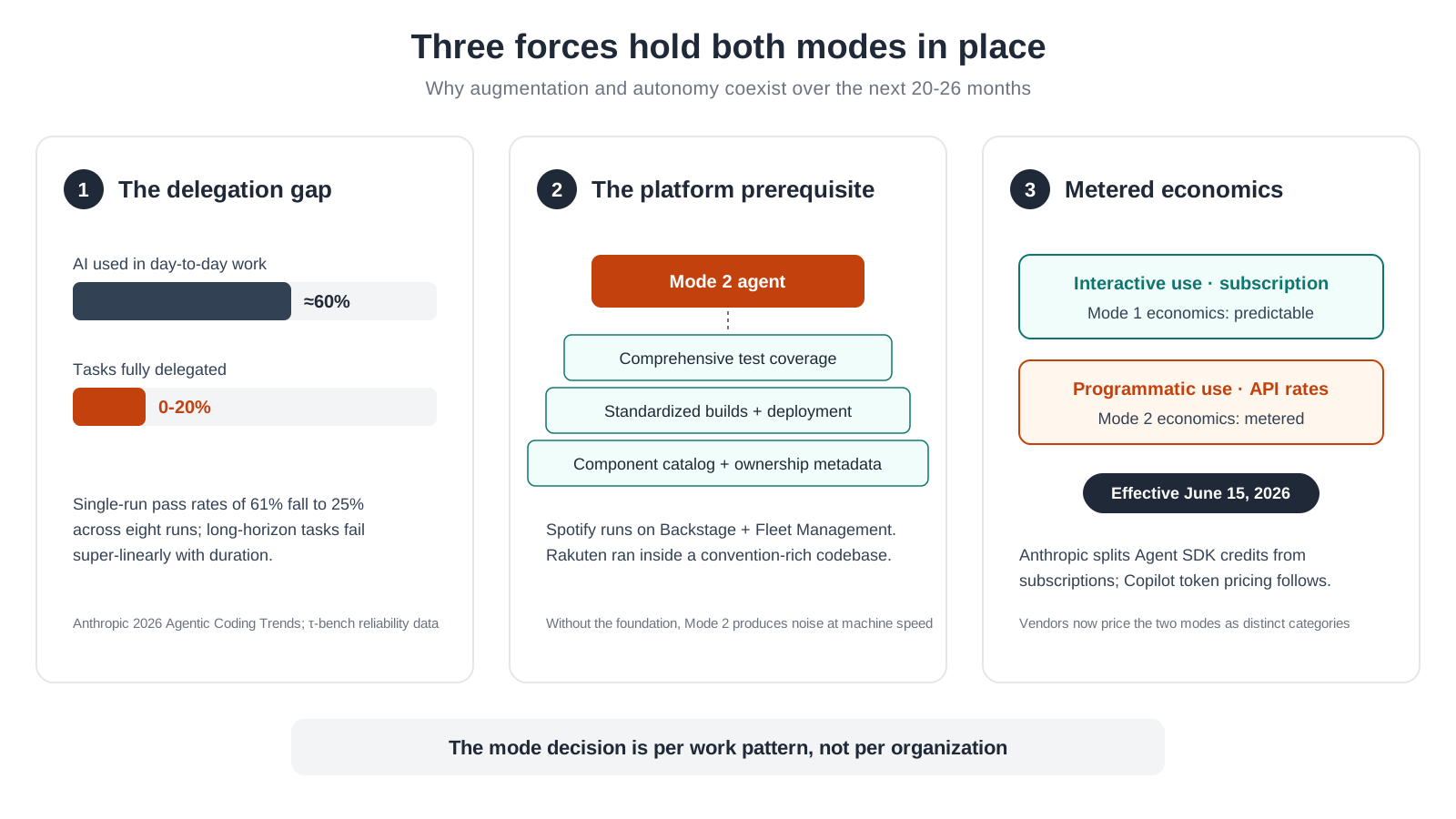
The delegation gap. Anthropic’s 2026 Agentic Coding Trends Report finds engineers using AI in roughly 60% of their work while fully delegating only 0 to 20% of tasks. Reliability research explains the gap: an agent that passes a task 61% of the time on a single attempt succeeds on all eight repeated runs only 25% of the time, and long-horizon tasks fail super-linearly with duration. Mode 2 has to be engineered for failure recovery, and most organizations have not built that machinery yet.
The platform prerequisite. Every flagship Mode 2 case rests on heavy platform investment. Spotify’s agent operates on top of Backstage and Fleet Management. Rakuten’s session ran against a mature codebase with strong conventions and comprehensive tests. Without component catalogs, standardized builds, and deep test coverage, Mode 2 produces noise at machine speed. Many enterprise estates remain years away from that foundation.
The economics. Anthropic’s May 13 pricing change, effective June 15, separates interactive subscription usage from programmatic Agent SDK usage billed at full API rates. GitHub Copilot’s move to token-and-credit pricing tracks the same pattern. As of June 15, 2026, the two modes carry different price tags: predictable subscriptions for augmentation, metered consumption for agentic loops. Vendors have built their pricing around the split persisting.
How the modes compare
| Dimension | Mode 1 | Mode 2 |
|---|---|---|
| Velocity on well-fit work | ●●●○○ | ●●●●● |
| Cost predictability | ●●●●● | ●○○○○ |
| Evidence maturity | ●●●●○ | ●●○○○ |
| Tolerance for ambiguous specs | ●●●●○ | ●○○○○ |
| Infrastructure prerequisites | ●●○○○ | ●●●●● |
The table reads as a portfolio, and that is the operational takeaway. The mode decision is per work pattern, not per organization. The same engineering group can run Mode 1 on brownfield maintenance and Mode 2 on a bounded migration backlog at the same time. Rakuten runs two agent harnesses in production; Spotify runs Mode 2 fleet maintenance while its feature teams work in Mode 1. The hybrid is the production reality, and the medium term belongs to organizations that route each pattern to the right mode.
Where the series goes
Article 2 lays out the Mode 1 playbook: harness design, work-type segmentation, and the build-versus-maintain cost inversion. Article 3 covers the Mode 2 playbook: the caged loop, the four orchestration patterns, and cost governance. Article 4 delivers the selection framework: five variables that determine where any work pattern lands. Each article compresses a full-length technical companion available for follow-up discussions.
Both engines are real. The discipline is knowing which one the maneuver calls for.