

Executive summary
Mode 1, the augmentation operating model defined in Part 1, is where most enterprise AI value is captured today, and most of it leaks through three gaps. First, the harness: three independent benchmarks published this year show the scaffolding around a model swinging coding results by 16 to 36 points with the model held constant, more than most model upgrades deliver. Second, work type: returns run from 30 to 40% on greenfield work in popular languages to zero or negative on brownfield maintenance, and a single org-wide policy buries the difference. Third, ownership: generated code is cheap to produce and expensive to own, and teams that skip reserving capacity for comprehension accumulate debt at machine speed. The playbook follows directly: invest in the harness, segment the work, and instrument ownership costs from day one.
Precision under direct control
Part 1 established that the impulse engine carries most of today’s load; this article is how to run it without the debt. An impulse engine does close-quarters work: docking approaches, orbital corrections, station-keeping. Nothing about it is glamorous, and everything about it is exacting: short bursts of thrust, applied under direct control, against references the pilot can verify. Mode 1 runs on the same temperament. The gains go to teams that treat the exacting part as the job itself. 🖖
The harness is the investment
Through 2025 the default assumption was that coding results track model quality, and procurement behaved accordingly. The benchmark record now says otherwise. In Endor Labs’ agentic code security benchmark, GPT-5.5 scored 61.5% on functionality inside OpenAI’s native Codex harness and 87.2% inside Cursor’s, a 25.7-point swing from the harness alone. On Terminal-Bench 2.0, Claude Opus moved 16 points, 77% to 93%, between a default CLI configuration and a tuned IDE harness. On CORE-Bench, the same model ranged from 42% on a minimal scaffold to 78% on a full harness, a 36-point spread driven entirely by what surrounds the weights.
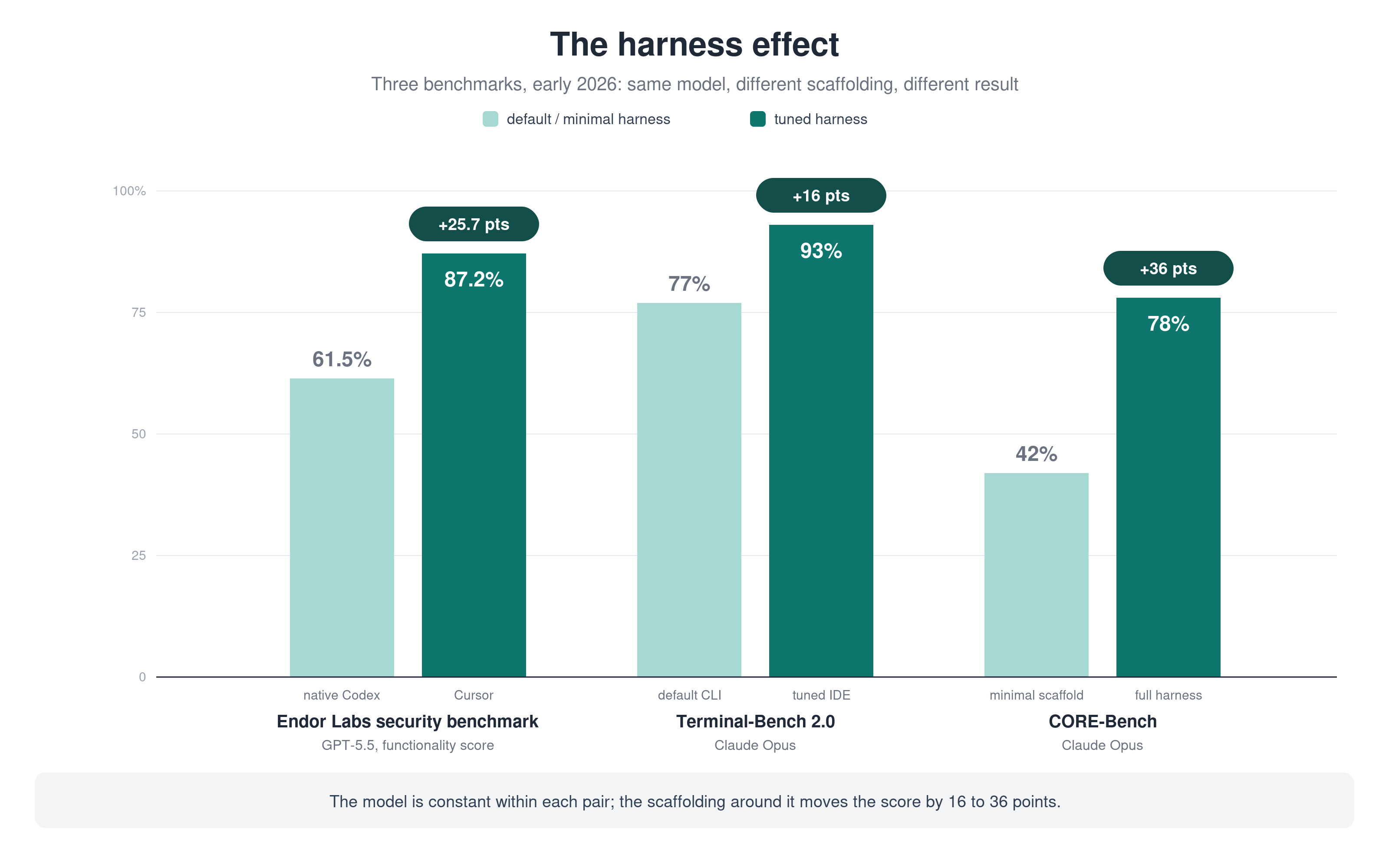
That record relocates the Mode 1 investment. A harness is everything except the model: the system prompt, the retrieval strategy, the permission model, the tool surface, the memory files, and the verification loops that let an agent check its own work. Martin Fowler’s taxonomy splits these into guides, which steer the agent before it acts (architecture docs, conventions, AGENTS.md), and sensors, which catch it after (linters, type checkers, test runners). Most of both live in the codebase rather than the tool. Sub-five-minute feedback loops, test suites an agent can run unattended, and intent documentation are codebase properties, and they demand maintenance like any other. The discipline extends to the guidance files themselves: an ETH Zurich study found human-written AGENTS.md files improved agent performance by roughly 4%, while LLM-generated ones degraded it by more than 20%. Agent readiness is not a procurement decision; it is codebase health, measured in feedback-loop latency and verification coverage. One caveat travels with the benchmark numbers: the same Endor Labs study found security scores below 25% across every harness tested, so a harness that verifies functionality has not yet verified safety.
Not all work responds equally
The work-type segmentation behind Part 1’s evidence is the planning instrument here, because the averages conceal the policy. The Stanford/P10Y data puts greenfield work in popular languages at 30 to 40% productivity gains. Complex new development inside existing constraints lands near zero. Brownfield maintenance runs zero to negative, the slowdown result covered in Part 1. The spread between work types is wider than the spread between tools: which work the agent touches matters more than which assistant the organization standardizes on.
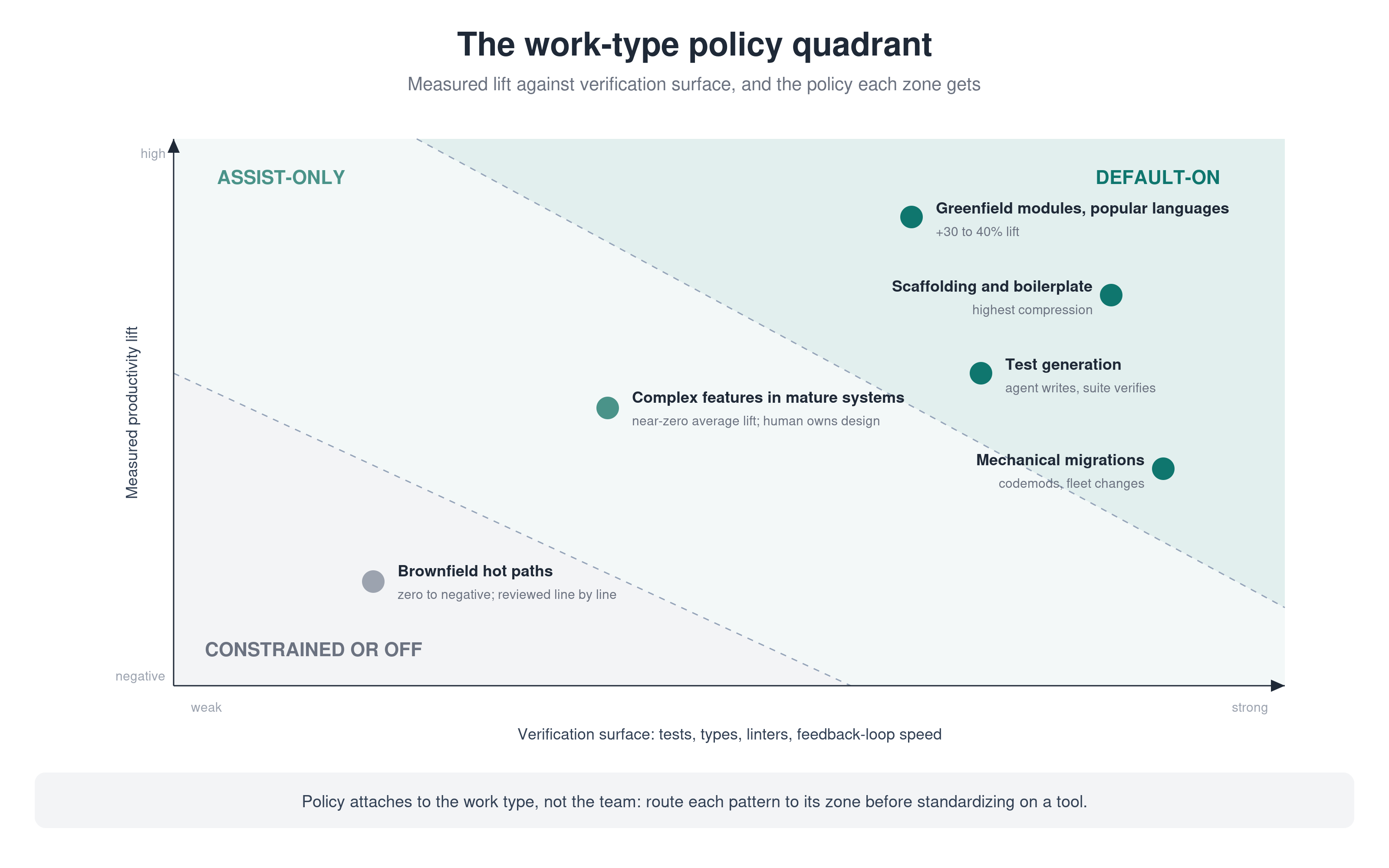
The operational form is a policy per work type, not per team. Default-on for scaffolding, test generation, migrations with mechanical verification, and greenfield modules. Assist-only for complex feature work in mature systems, where the agent drafts and a human owns the design. Constrained, or off, for brownfield hot paths where the controlled evidence shows experienced engineers losing time. Organizations that set one policy for everything average these segments together, report the 10 to 15% median, and wonder where the advertised gains went.
Generation is cheap; ownership is not
Mode 1’s costs arrive on a different schedule from its benefits. Generation effort collapses immediately. Ownership effort, the reviewing, understanding, debugging, and maintaining, stays human and grows with output volume. Addy Osmani named the gap comprehension debt in March 2026: code that passes tests and merges cleanly while the understanding needed to maintain it never gets built. Telemetry analyses put agent output at five to seven times the speed of human comprehension, and a January 2026 Anthropic study found junior engineers using AI assistance scored 50% on comprehension quizzes against 67% for the group coding manually, on the same library.
| Activity | Mode 1 effort reduction |
|---|---|
| Drafting greenfield code | ●●●●○ |
| Generating tests and scaffolding | ●●●●○ |
| Boilerplate and documentation | ●●●●● |
| Reviewing agent output | ○○○○○ |
| Understanding code in production | ○○○○○ |
| Maintaining brownfield systems | ●○○○○ |
The table is the cost inversion: the activities agents compress were already the cheap ones, and the activities they leave untouched, or inflate, were already the expensive ones. The planning consequence is a standing reserve, 30 to 40% of engineering capacity, held for comprehension work: review, documentation of intent, and refactoring for understanding. Three leading indicators tell a team whether the reserve is sized right. Review time per merged PR, where a rising trend signals output outpacing scrutiny. Time-to-understand, measured when an engineer first touches agent-written code in anger. And incident rate per 1,000 agent-generated lines, read against the human baseline.
The director skill set
The skill set that runs this playbook is directorial rather than mechanical, and it concentrates in four places. Problem decomposition: cutting work into units an agent can complete and a verifier can check. Context engineering: assembling the conventions, constraints, and intent documents the harness feeds forward. Review of unfamiliar code: evaluating logic the reviewer neither wrote nor chose to receive. And change leadership, because the engineers with the deepest verification instincts are often the most senior, and the evidence gives their skepticism standing. Mode 1 maturity looks less like prompt expertise and more like an engineering organization that already knew how to specify, verify, and review, now doing all three at higher volume.
Where the playbook ends
The thread through all four sections is the same discipline: agents accelerate what they can verify, and context, eval design, and judgment stay human. What this playbook does not cover is the moment the human leaves the loop and the agent plans, builds, and verifies on its own. The rules change there. That is Part 3, bounded autonomy at machine speed.